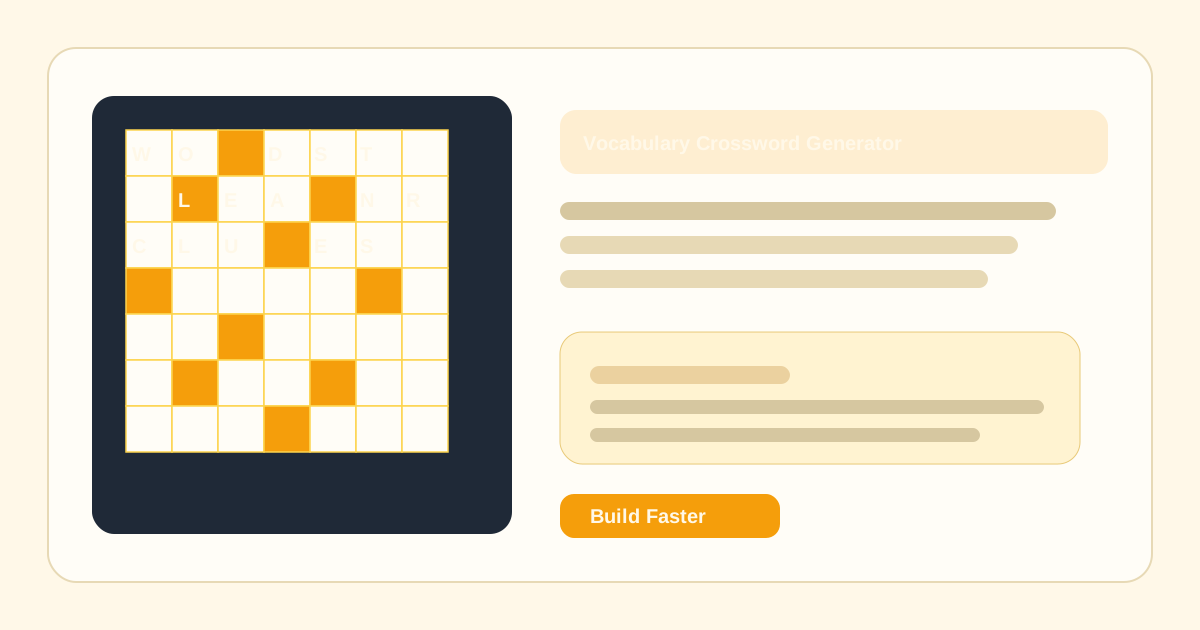
Crossword puzzles for ESL students give teachers a rare combination of vocabulary review, spelling practice, and speaking support inside one low-prep activity. When the word list matches the lesson and the clues stay simple, the puzzle feels like a game instead of one more worksheet.
That balance matters in language classrooms. For ESL teachers, a short crossword can reinforce target terms, slow down careless spelling mistakes, and create natural pair-work conversations without adding much planning time.
Why Crossword Puzzles for ESL Students Improve Retention
A well-designed puzzle asks learners to recall meaning, match letters, and confirm answers through crossing words. That process is useful because it combines retrieval practice with immediate feedback. If one answer is wrong, another clue usually exposes the mistake.
For teachers, the format is flexible. You can use it as a warm-up, a review activity, homework, or a fast assessment at the end of a unit. The same structure works for beginners, older students, and mixed-ability groups as long as the word list is realistic.
Another advantage is confidence. Many learners will attempt a puzzle before they will volunteer to speak in front of the class. That lower-pressure format gives them more chances to succeed.
How to Choose the Right Words by Level
The best list is focused, teachable, and short enough to finish in one sitting. Start with the lesson objective, then pick words that students have already seen once or twice in reading, listening, or direct instruction. In an ESL classroom, familiar context is often more important than clever clue writing.
Beginner Level (A1-A2)
For early learners, choose concrete words they can picture quickly:
- Family members
- Food and drinks
- Colors
- Animals
- Classroom objects
- Daily routine verbs
Keep most answers between 3 and 7 letters. Shorter entries reduce frustration and help younger learners finish with less support.
Intermediate Level (B1-B2)
For mid-level classes, build lists around practical themes:
- Travel and transportation
- Jobs and workplaces
- Health and body vocabulary
- Technology words
- Weather and environment terms
At this stage, clues can include short sentence contexts instead of simple definitions. That pushes students to process meaning instead of guessing from one-word hints.
Advanced Level (C1-C2)
For advanced groups, choose academic or abstract vocabulary:
- Cause and effect language
- Argument and opinion words
- Research terminology
- Social issues
- Unit-specific subject terms
Longer answers are fine here, but the clue should still be clearer than the target term. If the clue is harder than the answer, the activity stops teaching and starts filtering for already-strong students.
Build the Puzzle in 5 Classroom-Friendly Steps
Step 1: Pick One Theme
A tight theme gives the activity a purpose. A list built around food, school supplies, weather, or a reading passage is easier for learners to solve than a random mix of unrelated answers.
Step 2: Limit the List
For most classes, 10 to 18 answers is enough. Fewer than that can feel too easy. More than that often turns a quick activity into a long, tiring one.
A good rule is simple:
- Beginners: 8 to 12 answers
- Intermediate: 10 to 16 answers
- Advanced: 12 to 20 answers
Step 3: Write Clues Students Can Actually Read
Keep clue language one step easier than the answer. Use short definitions, fill-in-the-blank prompts, or direct examples.
Examples:
- "You drink this when you are thirsty" (WATER)
- "A person who helps students learn" (TEACHER)
- "The season after summer" (AUTUMN)
Avoid jokes, culture-specific references, or clever wordplay unless you are teaching advanced learners who already understand those patterns.
Step 4: Generate the Grid
This is the part that should be fast. Amazing Crossword lets you paste the list, add clues, and generate a clean classroom-ready layout in seconds. You can export it, print it, or share it online without rebuilding the activity by hand.
Step 5: Test It Before Class
Solve the puzzle once yourself. Check for three things:
- Any clue that could have two answers
- Any answer that students have not learned yet
- Any section that looks crowded on paper or mobile
That two-minute review removes most classroom problems before they happen.
Free Crossword Puzzles for ESL Students: Template Ideas
If you want a faster start, build from lesson-ready themes instead of staring at a blank page.
Template 1: Daily Routine Words like wake up, breakfast, bus, homework, dinner, and sleep work well for elementary groups.
Template 2: Around Town Use words such as bank, park, library, station, hospital, and market for speaking-heavy units about directions and places.
Template 3: Science Vocabulary For upper grades, use topic sets like energy, planet, habitat, recycle, experiment, and climate.
These templates are easy to adapt. Swap in your own unit words, regenerate the grid, and keep the same activity structure.
Tips for Running the Activity in Class
Use pair work when possible. One student can read clues aloud while the other writes. That turns a quiet crossword worksheet into a speaking and listening task.
Time limits also help. Ten focused minutes usually creates better energy than an open-ended activity that drifts.
If a group is struggling, preteach two or three anchor words before handing out the page. Those early wins help students unlock the rest of the answers.
For homework or remote practice, share the live puzzle link instead of printing. Students can complete the activity on a laptop or phone, and you avoid paper issues altogether.
Common Mistakes to Avoid
Using too many new words If every answer is unfamiliar, students stop learning and start guessing. Keep most of the list in review territory.
Making clues too academic Shorter clues are usually better. Clear language helps learners focus on meaning instead of decoding the instruction itself.
Choosing awkward letter combinations A good generator will place difficult words when it can, but students still need patterns they can spell with confidence.
Turning one activity into a full test This format works best when it feels achievable. Save the trickiest vocabulary for follow-up tasks.
FAQ
Can I use Amazing Crossword for beginner ESL students?
Yes. Beginner ESL students do best with short, concrete words, simple clue language, and a smaller list. Start with familiar classroom or daily-life themes so students can solve enough answers early.
How many words should an ESL word puzzle have?
For most classes, 8 to 12 answers is a strong starting point. If your students read more confidently, move into the 12 to 18 range.
Can students solve the puzzle on their phones?
Yes. You can share a live link and let students complete the activity on mobile devices, which is useful for homework, centers, and remote lessons.
Should I preteach difficult words before the activity?
Usually yes. Previewing two or three key terms raises completion rates and helps weaker students join the task without waiting for teacher rescue.
Start Creating Your First Classroom Puzzle
Good classroom puzzles do not need to be elaborate. They need a focused word list, readable clues, and a crossword format students can finish with confidence.
If you want a faster workflow, try Amazing Crossword. You can build a polished activity in under a minute, export it without clutter, and reuse the same teaching routine across multiple units.